
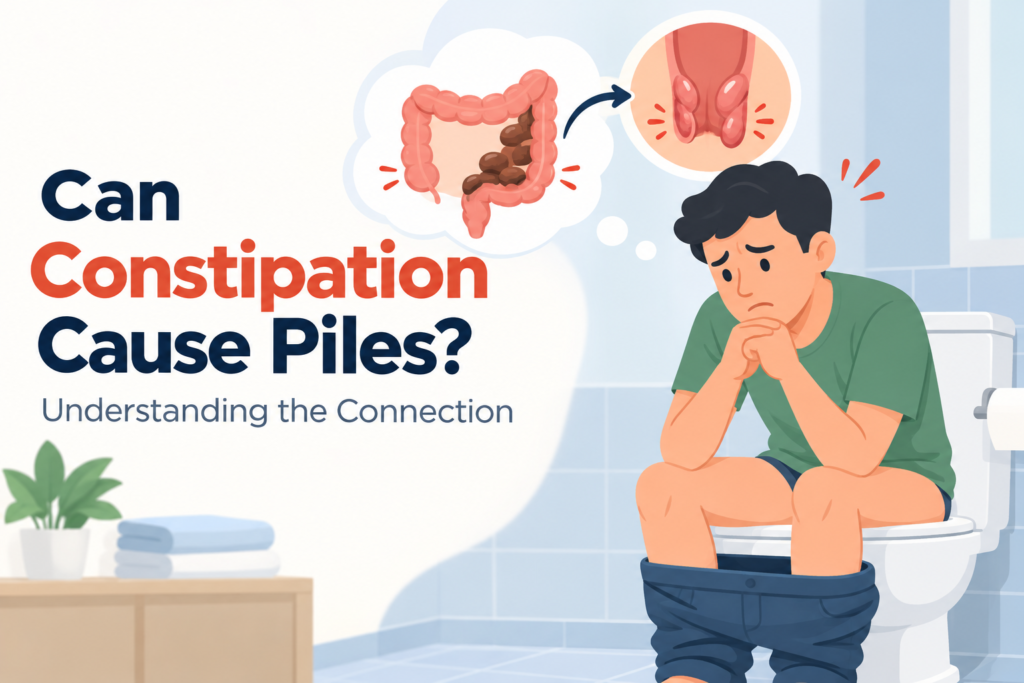
PilesYes, constipation can contribute to the development of piles, also known as haemorrhoids. When stools become hard or difficult to pass, people often strain during bowel movements. This repeated straining increases pressure around the veins in the anus and lower rectum, which can contribute to haemorrhoids.
However, constipation is not the only factor associated with piles. Pregnancy, ageing, prolonged toilet sitting, chronic diarrhoea, and other factors can also increase the risk.
According to the National Institute of Diabetes and Digestive and Kidney Diseases (NIDDK), chronic constipation and straining during bowel movements are recognised risk factors for haemorrhoids.
Understanding the relationship between constipation and piles can help you make better decisions about bowel habits, prevention, and when to seek medical care.
What Is Constipation?
Constipation occurs when bowel movements become difficult, infrequent, or incomplete.
- Hard, dry, or lumpy stools
- Difficulty passing stool
- Straining during bowel movements
- Feeling that the bowel has not emptied completely
- Having fewer bowel movements than usual
Some people with constipation have fewer than three bowel movements per week, although frequency alone does not determine whether someone is constipated.
The NIDDK’s guide to constipation explains that constipation can involve several symptoms, including difficult or painful bowel movements.
How Does Constipation Cause Piles?
Constipation does not automatically lead to piles, but it can create conditions that increase the risk.
1. Hard Stools Make Bowel Movements Difficult
When stool moves slowly through the colon, more water can be absorbed from it. This can make the stool harder and more difficult to pass.
Hard stools often require greater effort during bowel movements.
Over time, repeated straining can contribute to increased pressure around the anal and rectal veins.
2. Straining Increases Pressure
Straining is one of the most important connections between constipation and piles.
When you push forcefully to pass stool, pressure increases in the lower rectal and anal region.
Repeated straining may contribute to the swelling and displacement of haemorrhoidal tissue.
This is why reducing constipation and avoiding excessive straining are commonly recommended for people with piles.
3. Spending Too Long on the Toilet
People experiencing constipation may spend extended periods sitting on the toilet while trying to pass stool.
Prolonged toilet sitting is another recognised factor associated with haemorrhoids.
Avoid spending unnecessary time on the toilet, especially while using your phone or reading.
4. Repeated Constipation Can Worsen Existing Symptoms
If you already have piles, hard stools and repeated straining may aggravate symptoms such as discomfort, swelling, or bleeding.
Addressing constipation may reduce irritation and make bowel movements more comfortable.
For a broader discussion of haemorrhoid risk factors, read (What Causes Piles? Common Causes and Risk Factors).
Can Hard Stool Cause Bleeding?
Hard stools and straining can contribute to bleeding from haemorrhoids, but they can also cause or aggravate other anal conditions.
For example, an anal fissure is a small tear in the lining of the anus that may develop when passing hard stools.
Both piles and anal fissures can cause bright-red bleeding, but they are different conditions.
Rectal bleeding should not automatically be assumed to be caused by piles or constipation.
Other gastrointestinal conditions may also cause bleeding and require medical evaluation.
Read (Does Bleeding During Stool Always Mean Piles?) to understand why identifying the actual cause is important.
Can Constipation Make Existing Piles Worse?
Yes. Constipation can aggravate existing haemorrhoid symptoms, particularly when it causes repeated straining.
People with piles may experience:
- Discomfort during bowel movements
- Swelling around the anus
- Itching or irritation
- Bright-red rectal bleeding
- A lump around the anus
- Prolapse of internal haemorrhoids
However, these symptoms are not specific to piles, and significant pain or persistent bleeding warrants medical assessment.
You can learn about common symptoms in (10 Early Signs of Piles You Should Never Ignore).
How to Prevent Constipation and Reduce Piles Risk
Several dietary and lifestyle changes can help prevent constipation and reduce the need to strain during bowel movements.
1. Eat More Fibre
Dietary fibre helps add bulk to stool and can make bowel movements easier to pass.
Good sources include:
- Whole-wheat roti
- Oats and dalia
- Fruits such as guava, pears, and apples
- Vegetables
- Dal, beans, and legumes
- Nuts and seeds
The NIDDK’s constipation nutrition guidance recommends eating enough fibre and drinking adequate fluids to support regular bowel movements.
Adults generally need approximately 22–34 grams of fibre daily, depending on age and sex.
Increase fibre gradually to reduce bloating and gas.
For practical dietary recommendations, read (Foods to Avoid With Piles: What to Eat and What to Limit).
2. Drink Adequate Fluids
Fluids help fibre work effectively and can support softer stools.
Water is generally a good choice, but individual fluid requirements vary according to health, activity level, diet, and climate.
Drinking excessive amounts of water does not cure constipation or piles.
People with medical conditions requiring fluid restrictions should follow their healthcare professional’s advice.
3. Avoid Excessive Straining
Try not to force a bowel movement.
If stool does not pass easily, avoid prolonged pushing.
Repeated straining can increase pressure around the anus and rectum.
4. Avoid Prolonged Toilet Sitting
Spending long periods sitting on the toilet can contribute to pressure around the anal region.
Try to use the toilet when you feel the urge to pass stool rather than sitting and waiting for an extended period.
Avoid unnecessary distractions, such as scrolling through your phone.
5. Stay Physically Active
Regular physical activity may help improve bowel regularity.
Activities such as walking, cycling, or other suitable exercises can support digestive health.
Choose activities appropriate for your health and physical condition.
6. Maintain Consistent Bowel Habits
Try to establish a regular bowel routine.
For some people, attempting a bowel movement after breakfast may be helpful because eating can stimulate movement in the digestive tract.
Do not repeatedly ignore the urge to pass stool.
The NIDDK’s constipation treatment guidance describes dietary changes, physical activity, and bowel training as approaches that may help manage constipation.
Can Treating Constipation Help Piles Improve?
Yes. Treating constipation may help reduce straining and irritation, allowing mild haemorrhoid symptoms to improve.
However, correcting constipation does not guarantee that existing piles will disappear.
The outcome depends on the type, severity, and duration of symptoms.
According to NIDDK’s haemorrhoid treatment guidance, dietary changes and improved bowel habits are important parts of conservative management.
For more information about natural improvement, read (Can Piles Go Away on Their Own?).
What If Constipation Continues Despite Dietary Changes?
Occasional constipation may improve with changes in diet, hydration, activity, and bowel habits.
However, persistent constipation can have several causes, including:
- Medication side effects
- Changes in routine
- Inadequate dietary fibre
- Certain medical conditions
- Problems affecting bowel movement or pelvic floor function
A healthcare professional may recommend additional evaluation or treatments, such as fibre supplements or suitable laxatives.
Avoid repeatedly using stimulant laxatives or other constipation medicines without appropriate guidance.
Persistent constipation, especially when accompanied by bleeding, unexplained weight loss, or significant abdominal pain, should be medically evaluated.
Do All Constipation-Related Piles Need Surgery?
No.
Many patients with haemorrhoid symptoms can be managed without surgery.
Depending on the findings, treatment may include:
- Dietary changes
- Improved bowel habits
- Medicines for symptom relief
- Office-based procedures
- Surgery for selected cases
A doctor’s assessment helps determine which approach is appropriate.
The Mayo Clinic’s haemorrhoid treatment guide explains the available conservative and procedural treatment options.
For information about professional treatment, see (Piles Treatment in Indore).
When Should You See a Doctor?
Constipation and piles are common, but certain symptoms require medical attention.
Consider seeing a doctor if:
- Constipation continues despite dietary and lifestyle changes
- You have rectal bleeding
- You experience persistent or severe anal pain
- Piles repeatedly return
- You notice a persistent change in bowel habits
- You develop a painful lump around the anus
- You have unexplained weight loss
Seek urgent medical care for heavy or continuous rectal bleeding, fainting, severe abdominal pain, vomiting, or inability to pass stool or gas accompanied by significant abdominal swelling.
The NIDDK’s constipation guidance explains symptoms that warrant medical evaluation.
Piles Consultation at ProctoCare, Indore
If you experience persistent constipation along with bleeding, anal pain, swelling, or suspected piles, a medical examination can help identify the cause.
At ProctoCare, Indore, Dr. Sunil Kuril, MS (General Surgery), provides evaluation and treatment for piles and other anorectal conditions.
Not every patient requires a procedure or surgery. Treatment depends on the diagnosis and individual symptoms.
To learn more about available consultation and treatment options, see (Piles Doctor in Indore).
Frequently Asked Questions
1. Can constipation cause piles?
Yes. Constipation can contribute to piles because hard stools and repeated straining increase pressure around the veins in the anus and lower rectum.
2. Can hard stool cause piles?
Hard stools can make bowel movements difficult and increase straining, which may contribute to the development or worsening of haemorrhoids.
3. Can constipation cause bleeding during stool?
Constipation may contribute to bleeding through conditions such as haemorrhoids or anal fissures. However, rectal bleeding can have other causes and should be medically evaluated.
4. Will piles go away if constipation is cured?
Some mild haemorrhoid symptoms may improve when constipation and straining are reduced. However, treating constipation does not guarantee complete resolution of piles.
5. How can I prevent constipation naturally?
Eating adequate fibre, drinking enough fluids, staying physically active, maintaining regular bowel habits, and avoiding unnecessary straining may help prevent constipation.
6. Can sitting on the toilet for too long cause piles?
Prolonged toilet sitting can increase pressure around the anal region and is associated with an increased risk of haemorrhoids.
7. Is constipation the only cause of piles?
No. Other contributing factors include pregnancy, ageing, chronic diarrhoea, heavy lifting, and prolonged toilet sitting.
8. When should I see a doctor for constipation and piles?
Seek medical advice if constipation persists, if you experience rectal bleeding, significant pain, recurrent symptoms, or other concerning changes in bowel habits.
Conclusion
Constipation can contribute to piles, particularly when hard stools lead to repeated straining and prolonged toilet sitting.
Improving dietary fibre intake, maintaining adequate hydration, staying physically active, and developing healthy bowel habits may reduce constipation and help manage haemorrhoid symptoms.
However, constipation is not the only cause of piles, and dietary changes alone may not resolve every case.
If you experience persistent constipation, rectal bleeding, or recurrent anal discomfort, consult a qualified healthcare professional for an appropriate diagnosis.
For evaluation and treatment of piles in Indore, you can consult Dr. Sunil Kuril at ProctoCare.
(Internal Link: Piles Doctor in Indore)
Medical Disclaimer
This article is intended for general educational purposes and does not replace professional medical advice, diagnosis, or treatment. Persistent constipation, rectal bleeding, severe pain, or unexplained changes in bowel habits should be assessed by a qualified healthcare professional.